

Not sure what is causing water to enter your basement or foundation wall?
Call Now: 586-465-5500 or Request a Free Assessment Online
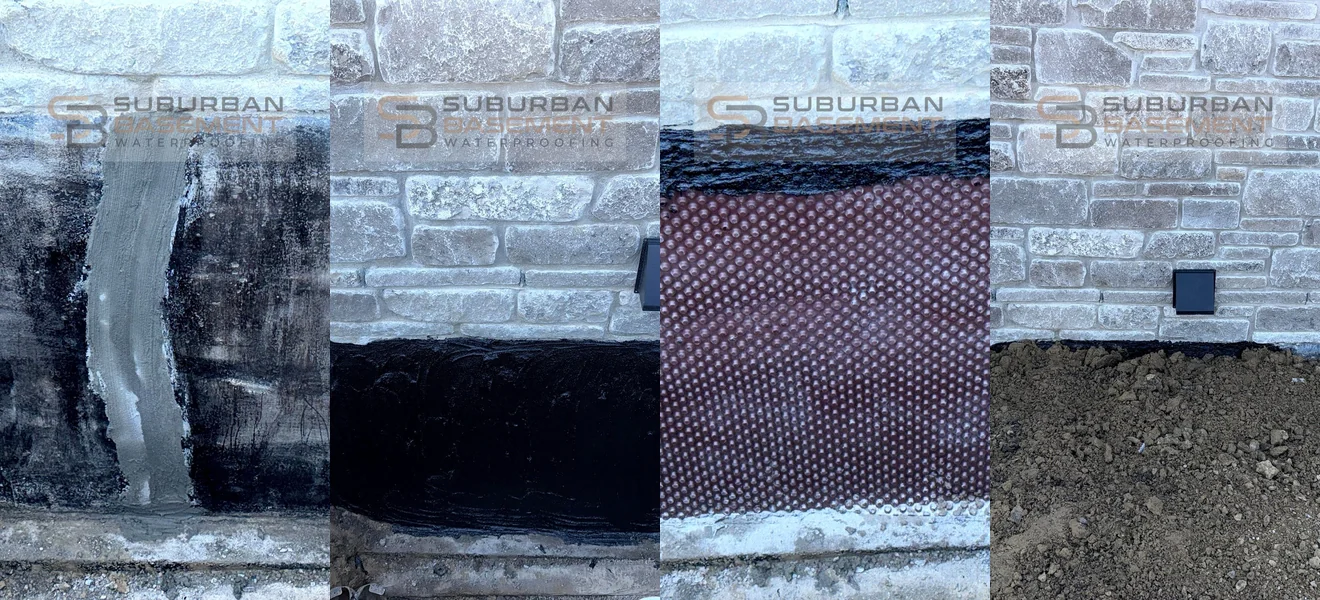
Exterior foundation waterproofing — sometimes referred to as exterior basement waterproofing — is used to address water intrusion by sealing and protecting the outside of the foundation wall.
Exterior waterproofing is the most complete long-term solution when the source of water is outside the foundation — not a patch from the inside, not managing water after it enters, but stopping it before it reaches the wall.
Call Now: 586-465-5500 or Request a Free Assessment Online
Exterior foundation waterproofing is a repair approach that addresses water intrusion at the outside surface of the foundation.
Instead of managing water after it enters, this method focuses on stopping it at the source by sealing and protecting the exterior wall.
It is often used when conditions outside the foundation are contributing to water intrusion and interior solutions alone are not sufficient.
Exterior foundation waterproofing is used when you have a leaking foundation wall, water seeping through from outside, or foundation walls where groundwater and surrounding soil are placing moisture against the structure. It may be used to address active leaks or as preventative protection before problems develop.
In some cases, property owners choose exterior waterproofing as a preventative measure to add protection before water intrusion issues develop.
Call Now: 586-465-5500 or Request a Free Assessment Online
Water buildup around foundation walls in SE Michigan is typically caused by clay soil, saturated ground, and poor drainage near the structure. Clay-heavy soils common throughout Macomb, Oakland, Lapeer, St. Clair, and Wayne Counties expand when wet and retain moisture through freeze-thaw cycles, increasing hydrostatic pressure against the foundation wall.
When soil becomes saturated from rain, snowmelt, or groundwater, pressure builds against the foundation. This pressure, known as hydrostatic pressure, can force water through cracks, joints, and porous materials.
Common causes include:
When water remains in contact with the foundation, the risk of intrusion increases. Exterior foundation waterproofing addresses this by sealing and protecting the foundation at the point where pressure occurs.
Call Now: 586-465-5500 or Request a Free Assessment Online
Each project is tailored to the specific conditions at the property. Exterior waterproofing may be completed in targeted areas or around the full perimeter, depending on what is needed to properly address the issue.
When needed, drainage components such as drain tile, cleanouts, or tied-in systems may be included as part of the repair.
The process generally involves:
Permits are obtained when required, and all work is completed in accordance with local building codes.
At Suburban Basement, we focus on addressing the source of the problem, not just the symptoms, for a long-term solution.
For engineers and contractors: Exterior foundation waterproofing — also specified as positive-side waterproofing in commercial and engineering documents — at Suburban Basement involves full excavation to the footing elevation, inspection and repair of structural cracks or defects, application of a bituminous waterproofing coating, and installation of a corrugated HDPE drainage board membrane bonded to the foundation face. Drain tile at the footing and cleanout access are included when conditions require active water management. Work is permitted when required and complies with local building codes. Available for residential, commercial, and industrial foundations throughout SE Michigan.
Call Now: 586-465-5500 or Request a Free Assessment Online
Exterior foundation waterproofing can be applied across a wide range of structures when conditions at the exterior foundation require direct access. Repairs may be completed in targeted areas or as a full perimeter system, depending on the structure, site conditions, and your preferences.
Best for: Basement wall leaks caused by soil moisture, clay soil expansion, groundwater pressure, or freeze-thaw cycles
Examples include:
Best for: Multi-unit and occupied structures in SE Michigan requiring controlled excavation and targeted exterior foundation waterproofing repairs
Examples include:
Best for: Large or complex structures in SE Michigan with groundwater exposure or deep foundation systems
Examples include:
Exterior foundation waterproofing is a flexible repair approach that can be adapted to different building types, helping address water intrusion conditions at the exterior foundation wall regardless of the size or complexity of the structure.
Call Now: 586-465-5500 or Request a Free Assessment Online
Exterior foundation waterproofing requires identifying the source of the problem and determining whether exterior access is the right solution. Suburban Basement provides condition-based exterior waterproofing throughout SE Michigan — Macomb, Oakland, Lapeer, St. Clair, and Wayne Counties — backed by a lifetime transferable warranty. Why property owners choose us:
We determine how and where water is affecting the foundation before recommending a solution.
Repairs are recommended based on actual conditions, not as a one-size-fits-all approach.
Residential, commercial, and industrial foundation experience.
Added confidence in long-term performance.
Call Now: 586-465-5500 or Request a Free Assessment Online
Exterior foundation waterproofing at Suburban Basement includes a lifetime transferable warranty. The warranty stays with the home and transfers to the next owner if the property is sold.
Most exterior foundation waterproofing projects are completed in 1 to 7 days. The timeframe depends on the linear footage being treated, soil conditions, site access, and whether drain tile or other work is required.
The recommendation is based on findings from an on-site assessment. Our team evaluates the source and path of water intrusion, structural conditions, and site-specific factors before recommending an approach. Exterior waterproofing stops water at the source; interior systems manage water after it enters.
Some impact to landscaping is possible during excavation. We take steps to minimize disruption, including laying plywood to protect lawns where possible. Specific concerns about landscaping can be discussed during your free assessment.
Yes. All exterior foundation waterproofing work at Suburban Basement is covered by a lifetime transferable warranty. Coverage remains with the property if the home is sold.
The excavated area needs time for soil settling before new concrete flatwork, driveways, or patios can be installed over it. Your project team can provide a specific timeline based on your site conditions.
The most common causes are clay soil, hydrostatic pressure, and deteriorated coatings. Clay soil retains water and expands against the foundation. Hydrostatic pressure from saturated ground pushes water through cracks and pores. Original builder's tar coatings dry out and fail over time, leaving the wall unprotected.
Yes. Call 586-465-5500 or submit a request online to schedule a free on-site assessment. We evaluate your foundation conditions before recommending any repair.
Hydrostatic pressure is the force created when water builds up in the soil surrounding a foundation. In SE Michigan, clay soils retain water and expand during wet seasons and freeze-thaw cycles, generating significant pressure against foundation walls. As that pressure increases, it can push moisture through cracks, joints, or porous areas of the foundation — making exterior waterproofing the most direct solution.
A waterproofing membrane is a protective material applied to the exterior surface of a foundation wall to create a barrier against groundwater and moisture intrusion. At Suburban Basement, exterior foundation waterproofing in SE Michigan typically involves a bituminous waterproofing coating followed by a corrugated HDPE drainage board membrane bonded to the foundation face.
Excavation is the process of removing soil around a foundation to expose the exterior wall down to the footing elevation so waterproofing repairs can be performed. In SE Michigan, excavation must account for clay soil conditions, which can retain water and make access more challenging. Suburban Basement uses excavation as part of every exterior foundation waterproofing project when required to reach the affected area.
A foundation crack is an opening in the foundation wall that can allow water to enter the structure. Cracks form due to settlement, hydrostatic pressure, freeze-thaw cycles, or changes in soil conditions — all common in SE Michigan. When water is entering through exterior foundation cracks, sealing from the outside is often the more effective long-term solution than interior patching.
Soil saturation occurs when the ground around a foundation becomes fully soaked with water, increasing pressure against the structure and the likelihood of moisture intrusion. In SE Michigan, clay-heavy soils are especially prone to saturation and slow drainage, and freeze-thaw cycles cause repeated expansion and contraction that worsens pressure against the foundation wall over time.
Exterior drainage conditions refer to how water flows and collects around a structure based on grading, soil type, and drainage systems. Poor exterior drainage is one of the most common causes of foundation water intrusion in SE Michigan, where clay soils, flat lots, and heavy spring snowmelt create persistent groundwater buildup along foundation walls.
Targeted exterior foundation waterproofing involves excavating and waterproofing a specific section of the foundation where water intrusion has been identified, rather than the full perimeter. This approach is commonly used in SE Michigan when a single wall or corner is the source of the problem, keeping disruption and cost to the affected area only.
Full perimeter exterior foundation waterproofing involves excavating and waterproofing the entire foundation from the outside. This approach is recommended when water intrusion affects multiple walls, when the original builder’s waterproofing has failed across the full structure, or when ongoing groundwater pressure from SE Michigan clay soils requires comprehensive protection.
Groundwater is water that exists within the soil surrounding a foundation. In SE Michigan, high groundwater levels from heavy spring rains, snowmelt, and clay soils that slow drainage are among the most common contributors to exterior foundation water intrusion. When groundwater builds up against the foundation wall without proper drainage or waterproofing, it creates the hydrostatic pressure that forces moisture through.
Foundation settlement is the movement of a structure caused by changes in the soil beneath or around it. In SE Michigan, clay soils that expand when wet and contract when dry contribute to settlement over time, as do freeze-thaw cycles that shift soil repeatedly. Settlement can affect drainage patterns and create low spots where water collects against the foundation wall.
A perforated pipe installed at the base of the foundation footing to collect and redirect groundwater away from the structure. In SE Michigan, drain tile is included as part of exterior foundation waterproofing when site conditions require active water management — particularly where clay soils slow drainage and groundwater accumulates at the footing level.
An asphalt-modified tar material applied directly to the exterior surface of a foundation wall to create a flexible, waterproof barrier. Not all coatings are equal — many builders and some contractors apply a thin brush-on or spray-grade version. Suburban Basement uses a trowel-grade coating, significantly thicker and more durable. The original builder’s tar dries out and cracks over time; trowel-grade application bonds more effectively and provides a longer-lasting seal before the drainage board membrane is installed.
The repeated process of groundwater freezing and expanding in cold temperatures, then thawing and contracting as temperatures rise. In SE Michigan, freeze-thaw cycles occur multiple times each winter and place significant stress on foundation walls and exterior waterproofing materials. Clay soils that retain water are especially vulnerable — the repeated expansion and contraction worsens hydrostatic pressure and can accelerate the failure of thin or aged exterior coatings.
The examples below show exterior foundation waterproofing in progress, including coating, crack repair, drainage installation, membrane protection, and other steps used to help stop water before it reaches the structure.
Helpful basement tips, seasonal advice, and exclusive offers — direct to your inbox.

Based in Macomb County, we have proudly provided basement waterproofing services throughout Southeastern Michigan since 2003. At Suburban Basement Waterproofing, we offer:
» Free estimates
» Extraordinary attention to detail
» Lifetime transferable warranty
Utica, Michigan 48317
Ask us about financing options




© Copyright 2026 Suburban Basement Waterproofing. All rights reserved.


