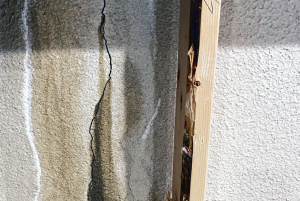


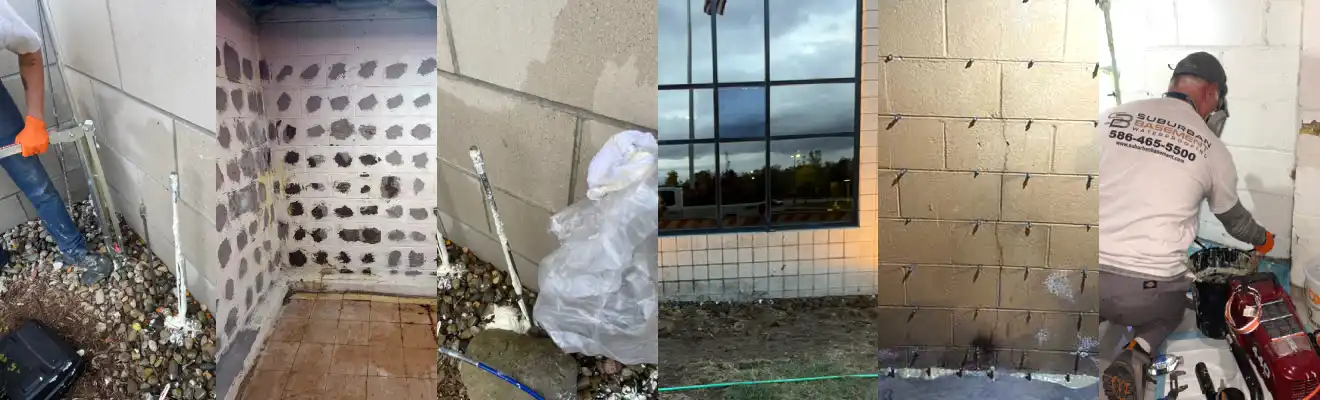
Curtain grouting in Southeast Michigan — interior resin injection, exterior injection lances, and cured grout sealing a foundation wall

Curtain Grouting Services in Southeast Michigan

No-Dig Foundation Leak Repair When Excavation Isn’t Possible

Residential, Commercial & Industrial Applications

Curtain grouting provides a practical solution for stopping foundation wall leaks when exterior excavation is not possible.


Instead of tearing up patios, driveways, or landscaping, this targeted injection method seals hidden water paths behind the wall and blocks groundwater intrusion at its source.


At Suburban Basement Waterproofing, we use professional-grade polyurethane curtain grouting systems to address below-grade foundation leaks in residential, commercial, and industrial structures across Southeast Michigan.

Dealing with a foundation leak but excavation isn’t an option?

What is Curtain Grouting?

Curtain grouting — also called curtain injection or building a grout curtain — is a no-dig, geotechnical repair method that stops groundwater by injecting expanding polyurethane resin into the soil behind a foundation wall. The resin forms a continuous barrier against the outside face of the wall, blocking water before it ever reaches the concrete. The curtain always forms on the outside face of the wall — that is what makes it positive-side waterproofing applied from the negative side, sealing water out at the wall rather than managing it once it is already inside. What changes from job to job is how we reach the soil: injection ports, also called injection packers, drilled through the wall, or injection lances, sometimes called injection probes, driven down into the soil. Access dictates which, and it is not simply a question of working indoors or out — on one Bruce Township job the lances went in from the garage floor to reach a crack that could not be touched from inside the basement. We do it both ways, depending on access and what the site allows.

What Problems Curtain Grouting Solves

Curtain grouting is used when groundwater intrusion originates outside the foundation but exterior excavation is not accessible.


Professional polyurethane curtain grouting can help address:

This solution is ideal when traditional exterior waterproofing cannot be performed due to site limitations.

Seeing water but can’t find the source? Don’t wait for the damage to spread.

Request a free estimate and we’ll help you determine the right repair.

When Exterior Waterproofing Excavation Is Restricted

Foundation leaks caused by groundwater pressure and exterior water paths are often addressed using excavation-based waterproofing methods. However, physical limitations such as patios, driveways, neighboring structures, utilities, or property line restrictions can limit access to the exterior foundation wall.


Curtain grouting is used when those traditional solutions cannot be performed due to site limitations.


Common limitations include:

  • Patios, driveways, sidewalks, or decks built directly against the foundation
  • Additions or neighboring structures blocking exterior access
  • Property line restrictions or shared walls
  • Utilities, landscaping, or hardscaping that cannot be disturbed
  • Commercial or industrial conditions where excavation would cause major disruption

When water pressure builds outside the foundation and exterior access is restricted, groundwater is forced to find alternate paths through soil voids, porous concrete, or hidden cracks behind the wall.


Curtain grouting addresses these conditions by sealing exterior water paths from the inside, stopping groundwater before it enters the structure without excavation.


Most people do not arrive here looking for grouting. They arrive because water is coming through the foundation wall, because the basement leaks every time it rains hard, because there is a crack in the wall that weeps, or because water is showing up under a patio, a driveway or an addition where nobody can dig. The search that usually brings people here is some version of how to fix a wet basement without digging up the yard. Southeastern Michigan sits on expansive clay soil, which swells when it takes on water and presses against the wall, then shrinks back as it dries — opening the same paths again the following season.

How Our Polyurethane Curtain Grouting Process Works

Curtain grouting works by stopping groundwater before it reaches the foundation wall. Expanding polyurethane grout is injected into the soil surrounding the structure, either from the interior or exterior depending on access conditions. The material travels through soil channels and hidden voids, forming a continuous watertight barrier that blocks active water paths.


Injection access points are determined by site layout, foundation type, and surface constraints, not by a one-size-fits-all approach.


Our goal is to stop exterior groundwater intrusion at its source while minimizing disruption to the structure and surrounding surfaces.


Because the barrier is built in the soil rather than on the wall itself, curtain grouting is as much a geotechnical repair as a waterproofing one. The soil becomes part of the finished system.

What the Installation Involves

Every wall gets assessed before anything is drilled — foundation type, geotechnical conditions such as soil type and saturation, where water is actually entering, and whether the work runs from the interior or the exterior. Poured concrete, block, and stone each behave differently.

Working from the interior, injection ports are typically set in a diamond grid, around 18 to 24 inches apart, with the bottom row about six inches off the floor. That is the starting point, not a rule — every basement presents its own obstacles, and port locations often have to shift around utilities, finished areas, obstructions, and how the wall is actually built. If grout isn’t travelling to the adjacent port, the spacing tightens. Where the wall should not be drilled at all, injection lances — or probes — are driven down into the soil instead. That can be from outside along the foundation, or from an interior slab such as a garage floor where that is the only way to reach the right spot.

Water goes in ahead of the resin. Polyurethane grout is water-activated, so pre-wetting the soil means the curtain forms whether or not the wall is actively leaking at the time. Injection starts at the lowest row and works across, then moves up — each row sheds down over the one beneath it, the way roof shingles overlap.

Pressure starts low and comes up slowly. Pushing too hard too early cracks or spalls concrete instead of moving resin through soil. The grout expands into soil channels and voids, sets, and bonds into a continuous barrier. Coverage runs roughly five to nine square feet per gallon, depending on soil density and how much void sits behind the wall.

When the wall is finished, water is re-injected at low pressure through each port to confirm every hole is sealed. Ports are removed, the holes patched with hydraulic cement or non-shrink grout, and the work area cleaned up. Nothing outside gets dug up.

The Resin We Inject


The material is a single-component, moisture-activated, hydrophobic, closed-cell polyurethane injection resin, formulated at a low viscosity. It carries NSF/ANSI/CAN 61-2020 certification, the North American standard for materials in contact with drinking water.


Each of those properties does a specific job:

  • Single component — nothing gets mixed at the wall, so there is no ratio to get wrong under field conditions. The resin cures the same at the last port as it did at the first.
  • Moisture activated — groundwater triggers the reaction. Water is not the obstacle here, it is the catalyst, which is why a wet wall is the condition this material is built for.
  • Low viscosity — thin enough going in to travel into fine sand seams and hairline paths instead of stalling at the first open void it finds.
  • Hydrophobic — it repels water rather than absorbing it. It will not take on water, swell, and shrink back as the ground cycles wet and dry through the seasons.
  • Closed cell — every cell in the cured foam is sealed off from the one beside it, so water cannot wick through the curtain itself.


Certified for contact with potable water. NSF/ANSI/CAN 61 certification means the cured resin does not leach contaminants into drinking water. That matters in two directions. It clears the material for municipal and water-utility structures — reservoirs, treatment basins, wet wells, pump stations, tunnels and access shafts — where anything injected below grade has to be certified before it goes in. And in a house, it means sealing a wall near a water service line is not a concern.


It is the same resin used to curtain grout seawalls. A shoreline structure sits under constant hydrostatic head rather than the intermittent pressure a basement wall sees after a storm. A material that holds a seal in that environment has margin to spare on a residential foundation.

For Engineers and Contractors


Curtain grouting is a geotechnical repair, and it gets specified as one. Where a below-grade seepage problem sits behind an adjacent structure, a property line, or an active facility that cannot be taken out of service, these are the relevant details:

  • Methodpermeation grouting of the soil mass behind the wall to form a continuous grout curtain — a seepage cutoff on the positive side, placed from the negative side, executed from the interior through drilled injection ports (packers) or from the exterior through injection lances (probes).
  • Material — single-component, moisture-activated, hydrophobic, closed-cell polyurethane injection resin at low viscosity, certified to NSF/ANSI/CAN 61-2020 for contact with potable water.
  • Verification — low-pressure water re-injection through every port before demobilization, confirming the curtain is continuous and each penetration is sealed.
  • Site impact — no excavation, no dewatering, no loss of use. Where the surrounding soil is loose or the structure needs the ground beneath it tightened as well, consolidation grouting can be carried out at the same time. The work proceeds from inside an occupied building.


We work with geotechnical and structural engineers, general contractors, municipalities, and property managers across Southeastern Michigan. If you have a specification to meet, or a condition you want assessed before writing one, call 586-465-5500.


We are not a dealer for anybody’s system. Most of the large waterproofing companies in this market are franchises or dealer networks, which means every recommendation routes back to the one product line they are licensed to sell. We are independent. Curtain grouting, interior drain tile, exterior excavation and waterproofing, carbon fiber, steel bracing — we install all of them, so the recommendation is based on what the wall needs rather than what we are contracted to move. Sometimes that means telling you curtain grouting is the wrong answer for your situation.

What Curtain Grouting Actually Costs


A curtain grouting quote can look expensive on first read. Nine times out of ten it is being measured against the wrong number.


The honest comparison is not curtain grouting against some smaller repair. It is curtain grouting against everything exterior waterproofing actually requires on that particular wall:

  • Getting to the wall. Decks, porches, patios, driveways, walkways, steps, landscaping, retaining walls, air conditioning units and utility runs sitting over the excavation line all have to come out first. In a finished basement it can mean interior demolition instead.
  • The waterproofing itself. Excavation down to the footing, hauling and disposing of the spoil, wall preparation, membrane, drainage, stone and backfill.
  • Putting everything back. Whatever came out in the first step has to be rebuilt or replaced. That work is usually quoted by somebody else, which is exactly why it gets left out of the arithmetic.


Add those three together and the picture changes. Curtain grouting is done through injection ports from inside the wall, or through lances driven into the soil from outside, without opening the ground. Nothing gets demolished, so nothing has to be put back.


It is not always the cheaper answer, and we will say so when it isn’t. Where the exterior is wide open — no hardscape, no structures, clear access to the footing — excavation may be the better value, and there are conditions curtain grouting is not the right tool for. But where access is the problem, it is frequently less money all in, and a fraction of the disruption.

Applications for Residential, Commercial, & Industrial Properties

Curtain grouting is used across Southeastern Michigan to stop groundwater intrusion where exterior waterproofing is not accessible. This no-dig solution seals hidden voids and prevents water from migrating behind foundation walls.


Commercial and industrial work is frequently specified by geotechnical and structural engineers, general contractors, and property managers who need a repair that does not shut the building down.


Curtain grouting is used in the following property types:

Residential Applications


  • Basement foundation wall seepage
  • Water intrusion beneath patios, driveways, and decks
  • Exterior water paths behind foundation walls
  • Hydrostatic pressure at wall-floor joints
  • Long-term waterproofing for below-grade living spaces

Commercial Applications


  • Water intrusion in office and retail basements
  • Finished lower levels and tenant build-outs
  • Mechanical rooms and utility areas
  • Elevator pits and parking sublevels
  • Below-grade storage and archive areas
  • Commercial foundation walls exposed to groundwater pressure

Industrial  Applications


  • Utility corridors and service tunnels
  • Equipment rooms and manufacturing floor foundation perimeters
  • Concrete and masonry foundation walls
  • Below-grade plant basements
  • Industrial storage and loading areas
  • Facilities requiring waterproofing without shutdowns

These examples represent common situations where curtain grouting may be appropriate. A professional evaluation determines the right solution for your specific conditions.

If groundwater intrusion is impacting your property, our team can help.

Why Choose Suburban Basement for Curtain Grouting

Our goal is to provide curtain grouting solutions that are technically appropriate, cost-effective, and aligned with the long-term needs of your property.


Basements and below-grade structures in Southeast Michigan are affected by fluctuating groundwater levels, freeze-thaw cycles, and seasonal soil movement. Our repair recommendations account for these regional factors rather than relying on one-size-fits-all solutions.


We believe property owners should understand where water is entering and why a specific repair method is recommended. Our evaluations focus on clarity, realistic expectations, and transparent guidance so you can make informed decisions.

Suburban Basement

Locally Owned
Independently Operated
Licensed & Insured
For Over 20 Years

Serving: Southeastern Michigan

Foundation Leaking Where You Can’t Excavate?

We’re here to help. Get your free assessment today.

Frequently Asked Questions

What is curtain grouting?

Curtain grouting is a no-dig waterproofing method that stops foundation leaks by injecting expanding polyurethane grout behind the foundation wall. The grout fills hidden soil voids, seals cracks, and forms a watertight barrier that blocks groundwater intrusion before it enters the structure. This approach is often less disruptive and more cost-effective than full replacement.

When is curtain grouting used?

Curtain grouting is used when exterior waterproofing or excavation cannot be performed due to patios, driveways, decks, property lines, neighboring structures, or commercial site constraints. It provides exterior-level leak protection without disturbing landscaping or surrounding surfaces.

Is curtain grouting a permanent waterproofing solution?

Yes. Polyurethane grout expands, hardens, and bonds with surrounding soil and concrete, creating a long-lasting barrier against groundwater intrusion. When properly installed, curtain grouting can provide decades of waterproofing protection. Left unaddressed, washout often leads to hidden voids and shoreline instability.

Can it fix leaks with no visible crack?

Yes. Curtain grouting is often used when water is entering through porous concrete, hidden cracks, or soil channels behind the foundation wall. It addresses the exterior water path even when no visible interior crack is present.

Is it safe for homes and commercial buildings?

Professional polyurethane grout systems are designed for structural and waterproofing applications. When installed correctly, they remain contained behind the foundation wall and do not pose a risk to interior living spaces, utilities, or surrounding property.

Is curtain grouting disruptive?

No. Because the process is performed from the interior using controlled injection points, there is no large-scale excavation. This minimizes disruption for homeowners, commercial properties, and industrial facilities. No harmful materials are introduced into surrounding water sources.

How does curtain grouting compare to drain tile systems?

Drain tile systems manage water after it reaches the foundation. Curtain grouting stops groundwater intrusion before it enters the structure by sealing exterior voids and soil channels. The correct solution depends on site conditions and how water is entering. A professional evaluation helps determine feasibility.

Can curtain grouting be used in commercial or industrial buildings?

Yes. Curtain grouting is commonly used in mechanical rooms, utility areas, storage spaces, elevator pits, and below-grade commercial or industrial structures where groundwater intrusion must be controlled without excavation or operational shutdown. A professional evaluation helps determine feasibility.

What causes groundwater to leak through foundation walls?

Groundwater pressure, saturated soil, freeze-thaw cycles, and seasonal water table changes can force water through porous concrete, wall joints, and hidden exterior cracks. Curtain grouting blocks these exterior water paths when excavation is not feasible.

How do I know if curtain grouting is the right repair for my property?

A professional evaluation determines whether groundwater intrusion originates from exterior soil conditions, structural cracks, or other factors. Curtain grouting is recommended when exterior access is restricted and injection-based waterproofing is the most appropriate solution.

Is curtain grouting cheaper than exterior waterproofing?

Often, though not always, and the comparison is rarely one quote against another. Exterior waterproofing means excavating down to the footing, which usually means removing whatever sits over the dig — a deck, patio, driveway, steps, landscaping or utilities — and then rebuilding it afterward. That restoration is normally quoted by somebody else, which is exactly why it gets left out of the arithmetic. Curtain grouting is done through the wall or through lances in the soil, so nothing is excavated and nothing has to be put back. Where access is the obstacle, the all-in cost is frequently lower. Where the exterior is wide open and easy to reach, excavation can be the better value, and we will tell you when that is the case.

Curtain grouting or excavation — which does my house need?

It comes down to access and to what is actually causing the water. If the outside face of the wall can be reached without tearing out structures or hardscape, and the wall needs more than sealing — damaged block, failed coatings, no drainage at the footing — excavation lets all of that be addressed at once. If the leak is groundwater finding a path through the wall, and the exterior is blocked by a patio, an addition, a driveway, a property line or a neighbouring structure, curtain grouting seals it without disturbing any of that. Every wall gets assessed before either one is recommended: foundation type, geotechnical conditions such as soil type and saturation, where the water is entering, and what is sitting over the excavation line.

Curtain Grouting Glossary​
Curtain Grouting

A no-dig waterproofing method that uses polyurethane grout injection behind a foundation wall to seal hidden soil voids and block groundwater intrusion before it enters a basement or below-grade structure.

An expanding waterproofing material used in curtain grouting and injection-based repairs. It reacts with moisture, expands to fill voids, and forms a watertight barrier against groundwater.

A category of injection materials used for soil stabilization and waterproofing applications. In foundation repair, chemical grout systems are used to seal exterior water paths and prevent groundwater migration.

A repair method that uses controlled injection of polyurethane or chemical grout to seal cracks, voids, and soil channels without exterior excavation.

Water entering a basement or below-grade structure due to elevated water tables, saturated soil, or hydrostatic pressure acting against foundation walls.

Water pressure that builds in saturated soil surrounding a foundation. This pressure forces water through porous concrete, cracks, or wall-floor joints when exterior waterproofing is not accessible.

Hidden gaps or channels in the soil behind a foundation wall. These voids allow groundwater to migrate toward the structure and are sealed during curtain grouting.

A traditional method of foundation leak repair involving excavation around the foundation to apply waterproof membranes or drainage systems. Curtain grouting is used when exterior excavation is not feasible.

A category of foundation repair methods, including curtain grouting, that seal groundwater intrusion without large-scale excavation or disruption to patios, driveways, or landscaping.

The joint where the foundation wall meets the basement floor. Water intrusion at this location often results from hydrostatic pressure and exterior soil saturation.

Any portion of a building located below ground level, including basements, mechanical rooms, elevator pits, and utility corridors. These areas are especially vulnerable to groundwater intrusion.

Seasonal temperature changes that cause soil expansion and contraction. In Southeast Michigan, freeze-thaw cycles can increase soil movement and contribute to foundation cracks and groundwater intrusion.

An injection resin that repels water rather than absorbing it. Because it does not take on water, it holds its shape and its seal as the ground around it cycles wet and dry through the seasons — unlike a hydrophilic grout, which swells when saturated and shrinks back as the soil dries.

A cured foam structure in which each cell is sealed off from the cells around it. Water cannot travel through the material itself, so the curtain stays a barrier instead of slowly becoming a path.

A measure of how easily a liquid flows. A low-viscosity resin is thin going in, which lets it travel into fine sand seams and hairline paths rather than stopping at the first open void it reaches.

The North American standard for materials that come into contact with drinking water. Certification means the cured material does not leach contaminants into potable water, which is what allows it to be used on municipal water structures and near residential water service lines.

The pressure created by standing water, measured by the height of the water column above the point being considered. The higher groundwater sits against a foundation, the greater the head pushing water toward any opening in the wall.

Relating to the behavior of soil and rock and how a structure interacts with the ground it sits in. Curtain grouting is a geotechnical repair because the barrier is formed in the soil outside the wall rather than applied to the concrete surface.

The category of engineering methods that change how soil behaves — its permeability, density, or strength — instead of altering the structure resting on it. Grouting techniques, including curtain grouting, fall under ground improvement.

A fitting set into a hole drilled through the foundation wall from the inside, through which resin is pumped into the soil behind it. The two names are used interchangeably in the trade — a packer is the mechanical fitting that seals into the hole so grout goes outward under pressure instead of back into the room.

A steel rod driven into the soil from outside the building and used to inject resin at depth without drilling the wall at all. Lance and probe mean the same thing. This is the exterior approach, used when the outside is reachable but excavation is not practical.

CURTAIN GROUTING PHOTOS

The examples below show curtain grouting projects across Southeast Michigan, highlighting how groundwater intrusion develops, how exterior water paths are identified, and how injection-based waterproofing repairs are performed.

MORE WORKS

Similar Projects